Reviewing Evidence on Invention-Based Learning
In the educational literature, there is a controversy about using invention activities as part of learning: while some studies suggest that it is beneficial to involve students in activities where they invent solutions to new problems before receiving instruction, other studies suggest it is more beneficial to just provide the information.
Attending to that, we are collaborating with Stanford University and the University of Oviedo on a meta-analytical project that aims to synthesize this literature and evaluate the factors that explain these differences. Our methodological protocol has already been published in Campbell Systematic Reviews, a Q1 journal in the Science Citation Index and a reference of standards for systematic reviews and meta-analysis. Also, some preliminary results displayed in conferences are already informing about the superiority of invention-based learning when learning is evaluated in terms of deep conceptual understanding.
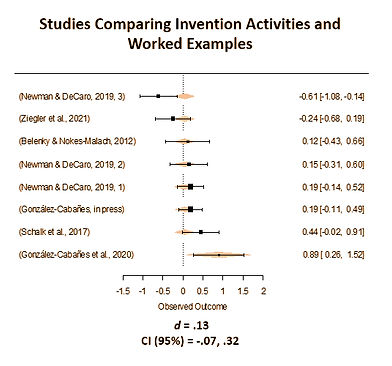
Note. Sample of reviewed results in the ongoing meta-analyses project.
Project Overview
-
Duration: 2 months for Protocol submission. (The systematic review is ongoing.)
-
Role: Eduardo González is leading the literature search, the data collection, and analysis.
-
Team: Team of 3 psychology researchers from Stanford University and the University of Oviedo.
-
Key Tools: EndNote (for study screening and management), Microsoft Access (for data coding), and R (for meta-analysis and meta-regression modeling).
-
Project Goal: Systematically review the literature to synthesize the evidence regarding the efficacy of invention activities to promote learning.
-
Methods: Exhaustive search of the literature and a meta-analysis to synthesize effect sizes about the efficacy of invention activities across contextual and intervention factors.


