
Predictions
Our process begins by defining action scenarios based on your strategic decisions. We use these scenarios to apply advanced predictive models to the data (e.g., Bayesian regression, bootstrapping, clustering) and simulate the most probable trajectories of results across all potential decisions.
Even in qualitative research, we leverage our findings to co-specify action scenarios with you and generate predictive hypotheses that inform subsequent actions and quantification studies.
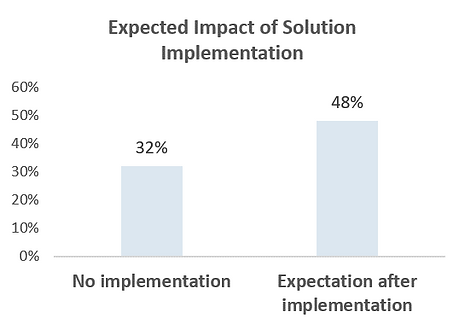
Note: Example of a visualization of the projected impact of a solution against the baseline scenario.
Uncertainty Assessments

Note: Visualization of uncertainty ranges for the prediction, accounting for sampling error and hypothesized temporal shifts.
We maintain full transparency on the uncertainty levels of our predictions. While our methods are designed for constant error minimization, some uncertainty remains unavoidable, as behavioral data is inherently subject to factors such as sampling bias, latent variables, and temporal shifts.
To manage this, we collaborate with stakeholders to map uncertainty factors and conduct sensitivity analyses that visualize potential outcome ranges. This ensures your decisions are not paralyzed by risk, but remain robust against calculated uncertainties.
Decision Guidance
We address the inherent complexities of corporate decision-making. We facilitate stakeholder discussions to contextualize results, review nuances, clarify trade-offs, and frame strategic choices with full awareness of calculated uncertainties. Our goal is to deliver a clear, executable path forward.

Evaluation of Follow-Ups
We contrast predictions with reality, revealing opportunities for immediate strategic adjustments and new growth.
We use impact evaluation methods like A/B testing, control groups, and temporal tracking. Beyond strategic benefits, calculating Return on Investment (ROI) motivates teams and drives a learning loop that refines research capabilities.

Note.This chart expands on the previous example to compare the actual KPI evolution against the predicted outcome range.

